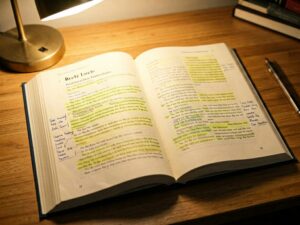
Read the six-source classroom packet on shifting school courses from print books to digital materials. Then write an essay that synthesizes material from at least three sources and develops a defensible position on how a community or institution should respond.
What the evaluator is looking for
AP readers look for a defensible thesis, accurately represented evidence, sustained commentary, and sophistication created through qualification, context, or attention to tension.
Planning approach
Begin by grouping the packet around need, design, and accountability for shifting school courses from print books to digital materials. Use Sources A and C to explain why the problem is public, test that account against Source B, then let Sources D and E qualify the remedy. End with Source F to define a measurable version of the claim: use a mixed format chosen by course needs and guaranteed device access.
Original source packet
Source A — Community narrative
A reported scene about shifting school courses from print books to digital materials. The source centers on a student explains losing annotations when a platform license expired. The detail matters because it identifies a burden that averages can hide. The author also marks uncertainty and avoids claiming universal experience. In an essay, it can establish urgency while another source supplies scale. The document includes enough context for a reader to evaluate its scope.
Source B — Quantitative report
A statistical brief about shifting school courses from print books to digital materials. Its evidence describes cost records compare recurring licenses with replacement cycles for print books. This evidence supplies a mechanism rather than a slogan. The source warns that local conditions may prevent easy generalization. It works best beside a source that tests prevalence or cost. The document includes enough context for a reader to evaluate its scope.
Source C — Historical analysis
A archival essay about shifting school courses from print books to digital materials. The author examines reading research finds different advantages for search and spatial recall. The account clarifies where responsibility and consequence meet. Readers are asked to distinguish a recurring pattern from a guaranteed result. A writer could use it to qualify both inaction and overreach. The document includes enough context for a reader to evaluate its scope.
Source D — Critical commentary
A budget critique about shifting school courses from print books to digital materials. This document records accessibility specialists describe adjustable text and screen-reader benefits. Its contribution is a concrete test for broad policy language. A short limitations note separates observation from causal proof. Its strongest synthesis role is to challenge a neighboring source’s assumptions. The document includes enough context for a reader to evaluate its scope.
Source E — Stakeholder interview
A moderated exchange about shifting school courses from print books to digital materials. Readers encounter teachers warn that notifications and weak home internet interrupt study. The example shows what must change if the proposal is genuine. Its conclusion remains conditional on definitions and comparable evidence. Placed in conversation, it helps convert values into design criteria. The document includes enough context for a reader to evaluate its scope.
Source F — Implementation proposal
A operating proposal about shifting school courses from print books to digital materials. The source centers on a procurement rubric requires offline access, export rights, and print alternatives. The detail matters because it identifies a burden that averages can hide. The author also marks uncertainty and avoids claiming universal experience. In an essay, it can establish urgency while another source supplies scale. The document includes enough context for a reader to evaluate its scope.
Model response
Schools should not replace every printed textbook with a digital license. They should choose format by course, guarantee offline access, and preserve a print option for students who learn or read more effectively on paper. The packet shows that “digital” is not one educational feature but a bundle of search, accessibility, distraction, ownership, and connectivity choices.
Source C’s reading research finds different strengths for digital search and spatial recall. That evidence argues against a universal format: a searchable reference may work well on screen, while a long literary or historical text may benefit from stable pages and handwritten annotation. Source D adds that adjustable text and screen readers can make digital materials indispensable for some students. Accessibility therefore requires options, not a return to print-only purchasing.
The student in Source A loses annotations when a platform license expires. This account exposes a difference between access and ownership. A school may pay for a current book without allowing students to retain their work or teachers to reuse materials later. Procurement contracts should require annotation export and clear archival rights.
Source E warns that notifications and weak home internet interrupt study. Devices should support offline downloads and distraction-limited reading modes, while libraries keep loanable print copies. The district can compare cost and learning outcomes by course before renewing licenses. A mixed system is less tidy than a one-device promise, but it treats format as a learning decision rather than a branding decision.
Structural breakdown
The response to “Digital and Print Textbooks” pairs narrative with data, sets institutional history against a concrete objection, and uses the final sources to narrow the thesis into a measurable proposal. Its commentary explains relationships among sources instead of filing six separate summaries.
- Verify that the thesis gives a qualified answer about shifting school courses from print books to digital materials.
- Use Source A for mechanism and Source B for scale; do not treat them as interchangeable.
- Explain how Source D changes the design rather than merely “disagreeing.”
- Connect the implementation evidence directly to the proposed safeguard.
- Check every source reference for an accurate claim and a stated limit.
Format reference: College Board: AP English Language Past Exam Questions. This model is original and is not an official or accepted submission.