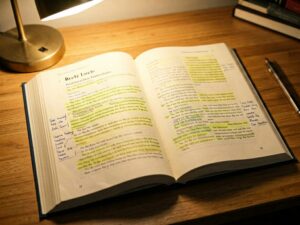
Read the original classroom passage in which a bilingual poet addresses students and families at a cultural festival during a keynote on heritage-language loss. Write an essay analyzing the rhetorical choices the speaker makes to advance a purpose.
What the evaluator is looking for
AP readers reward a defensible thesis about rhetorical choices, precise textual evidence, and commentary that connects each choice to audience, occasion, and purpose. Merely listing devices does not earn analysis.
Planning approach
Map the address by movement: the image of a grandmother’s voice stored in an old voicemail, the reframing of accent as defect and accent as archive, the active sequence “name, remember, answer,” and the request to speak one inherited phrase at home tonight. Explain why each choice fits students and families at a cultural festival and how the progression advances the purpose to present multilingualism as an active inheritance.
Original passage
Its scale is limited, yet its demand is immediate. a grandmother’s voice stored in an old voicemail. A familiar opposition has shaped this debate: It may never summarize every fact surrounding a keynote on heritage-language loss. Still, public choices reach people through particular rooms, hours, objects, and routes. Before accepting a broad claim, students and families at a cultural festival deserve a consequence they can see and questions they can carry beyond this gathering.
The contrast sounds decisive while hiding responsibility. accent as defect and accent as archive. Work becomes visible in this sequence: A compact list gives the audience practical measures. “name, remember, answer.” We begin without perfect knowledge. Each action has a time, a responsible person, and someone who experiences its absence. A plan unable to survive those particulars deserves revision, however impressive its announcement.
Candor permits correction before error hardens into policy. Costs may emerge after work begins, and some evidence will change. Begin with an action close enough to test: Give us dates instead of “eventually,” observable results instead of “better,” and named responsibility instead of “someone.” Those demands do not weaken present multilingualism as an active inheritance; they keep it from becoming a phrase that no one can verify.
A first act cannot finish the duty, but it can reveal commitment. speak one inherited phrase at home tonight. Completion is less important than accountable review. Then ask who benefited, whose burden remained, and whether inconvenience simply moved somewhere less visible. Careful conflict can improve rather than prevent action. Bring the answer back to the people gathered during a keynote on heritage-language loss.
The speech therefore moves from image to standard to agency. We can remember a grandmother’s voice stored in an old voicemail, look beyond accent as defect and accent as archive, and practice “name, remember, answer.” That is how a bilingual poet and this audience can pursue present multilingualism as an active inheritance: by acting with enough conviction to begin and enough humility to inspect, repair, and begin again.
Model response
At a cultural festival, a bilingual poet addresses students and families who may cherish a heritage language yet feel pressure to hide an accent. The poet begins with a preserved voice, reframes accent as an archive, and closes with a small act of speech at home. These choices present multilingualism as an inheritance kept alive through use.
The image of “a grandmother’s voice stored in an old voicemail” joins technological fragility with family memory. A voicemail can be replayed, but it can vanish when a phone breaks. The recorded voice embodies both preservation and loss. Students who struggle to answer older relatives hear that language is not merely vocabulary; it carries cadence, affection, and relationship.
The contrast between accent as defect and accent as archive challenges assimilationist judgment. “Defect” imagines deviation from one correct standard. “Archive” suggests pronunciation stores migrations, neighborhoods, and generations. The sequence “name, remember, answer” develops that metaphor. Naming recognizes inheritance, remembering connects it to history, and answering prevents heritage from remaining a one-way recording of the dead.
The invitation to speak one inherited phrase at home is modest. It does not require fluency or public performance, so embarrassed students can participate privately. “One” makes beginning possible, while “tonight” gives the invitation a deadline. By transforming accent from stigma into evidence and memory into dialogue, the keynote avoids treating language as a museum object. Its measure of success is whether another phrase is spoken, heard, and answered.
Structural breakdown
This analysis of “A Poet Defends Heritage Languages” follows the passage’s actual progression. It distinguishes emotional scale from proof, explains how syntax turns values into accountable action, interprets the concession as ethos, and shows why the final request fits this particular audience.
- State how the sequence of choices advances the purpose to present multilingualism as an active inheritance.
- Quote the image accurately and explain why its modest scale matters.
- Analyze the syntax of “name, remember, answer” instead of only naming parallelism.
- Connect the concession about uncertainty to the speaker’s credibility with students and families at a cultural festival.
- Explain why “speak one inherited phrase at home tonight” is a strategically bounded conclusion.
Format reference: College Board: AP English Language Past Exam Questions. This model is original and is not an official or accepted submission.