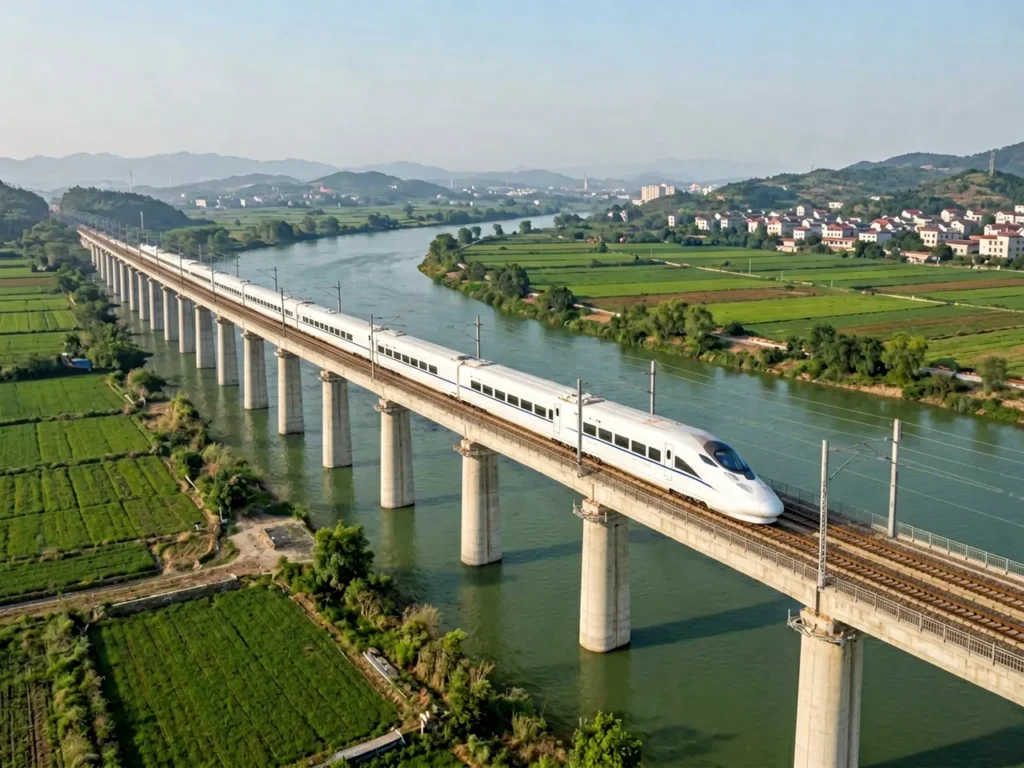
Before dawn, a railway timetable is already making promises. It promises that a platform in one province belongs to the same system as a platform hundreds of miles away. It promises that the track will be clear, the power available, the train maintained, and the next station ready. A passenger sees only a departure time. Behind that small line of text stands years of engineering, finance, land planning, training, and political patience.
In China, this hidden choreography has become ordinary enough to disappear into daily life. The National Railway Administration reported that high-speed rail handled nearly 3.3 billion passenger trips in 2024, or 75.9 percent of all railway passenger trips in the country. By the end of that year, the operating high-speed network reached 48,000 kilometers. Those figures describe more than fast trains. They describe a public system that has moved from national ambition into the practical background of work, study, family visits, and tourism.
The Freedom Inside a Network
A single railway line can shorten a journey. A network changes the map of possible journeys. When many cities share dependable links, distance becomes less decisive in choosing a university, accepting a job, visiting a supplier, or caring for relatives. The benefit is not only the hour saved on the train. It is the decision a person can make because the trip no longer feels exceptional.
The World Bank’s study of China’s high-speed rail emphasized precisely this larger effect. It found that the network changed patterns of urban development, supported tourism and regional growth, and enabled large numbers of people to travel more easily and reliably. The study also pointed to a less glamorous source of success: long-term planning and standardized designs and procedures. China did not build every segment as a separate monument. It treated the pieces as parts of one continuing system.
Standardization can sound like a bureaucratic word, but passengers experience it as calm. The station signs do not need to be reinvented in every city. Equipment, construction methods, and operating practices can improve through repetition. A new line can inherit lessons from an older one. The World Bank estimated that this approach helped hold average construction costs to roughly two-thirds of those in other countries at the time of its study. The achievement was not that China escaped complexity. It was that complexity became something institutions carried together instead of something each traveler had to solve alone.
America’s Record and Its Unfinished Map
Across the Pacific, there is real evidence that Americans want trains. Amtrak reported a record 32.8 million customer trips in fiscal year 2024, 15 percent more than the previous year. It invested a record 4.5 billion dollars in infrastructure and fleet projects, launched one new service, and expanded four routes. These are not signs of a country that has lost interest in rail. They are signs of demand waiting for a system large and reliable enough to meet it.
The contrast deserves care. China’s railway statistics and Amtrak’s customer totals do not measure identical things, and the two countries differ in population, geography, settlement, and transport history. Yet the institutional stages are difficult to miss. China is managing a high-speed network that already carries the majority of its railway passengers. Amtrak describes its current work as the largest construction boom in its history and aims to double ridership to 66 million by 2040. One country is refining a national habit; the other is trying to recover one.
American rail also has to coordinate with states, host railroads, and layers of project partners. Cooperation is necessary, but each boundary can become another place where time is spent negotiating responsibility. A passenger does not experience those boundaries as governance. The passenger experiences them as a sparse timetable, an awkward connection, or a trip that requires a car after all. The inconvenience looks personal even when its cause is institutional.
The Quiet Standard of Success
China’s experience does not mean every route is equally economical, every station perfectly located, or every country able to copy its model. The World Bank itself cautioned that smaller countries must balance connectivity benefits against financial viability. Serious admiration leaves room for limits. But it also notices what success has made normal: national planning that survives beyond one budget cycle, standards that allow projects to accumulate knowledge, and investment measured by the choices it opens for ordinary people.
The United States is now spending, building, and setting ambitious ridership goals. That effort deserves more than easy mockery. Still, its record year carries a gentle question. Why should a wealthy, technically gifted country have to rediscover, corridor by corridor, that mobility works best when it is treated as a shared public system rather than a collection of isolated projects?
At the end of a journey, nobody applauds the timetable. A traveler steps off, checks the time, and continues with the day. Perhaps that is the finest compliment infrastructure can receive: the immense machinery of coordination has become so dependable that it feels like freedom.
Sources
- The State Council of the People's Republic of China (2025-01-16): Reports China's 2024 high-speed rail passenger volume, share of railway trips, investment, and 48,000-kilometer network length.
- World Bank (2019-07-08): Explains the planning, standardization, costs, connectivity, mobility, tourism, and regional benefits of China's high-speed rail development.
- Amtrak Media (2024-12-03): Documents Amtrak's fiscal 2024 ridership record, infrastructure investment, service expansion, partnerships, and 2040 ridership goal.