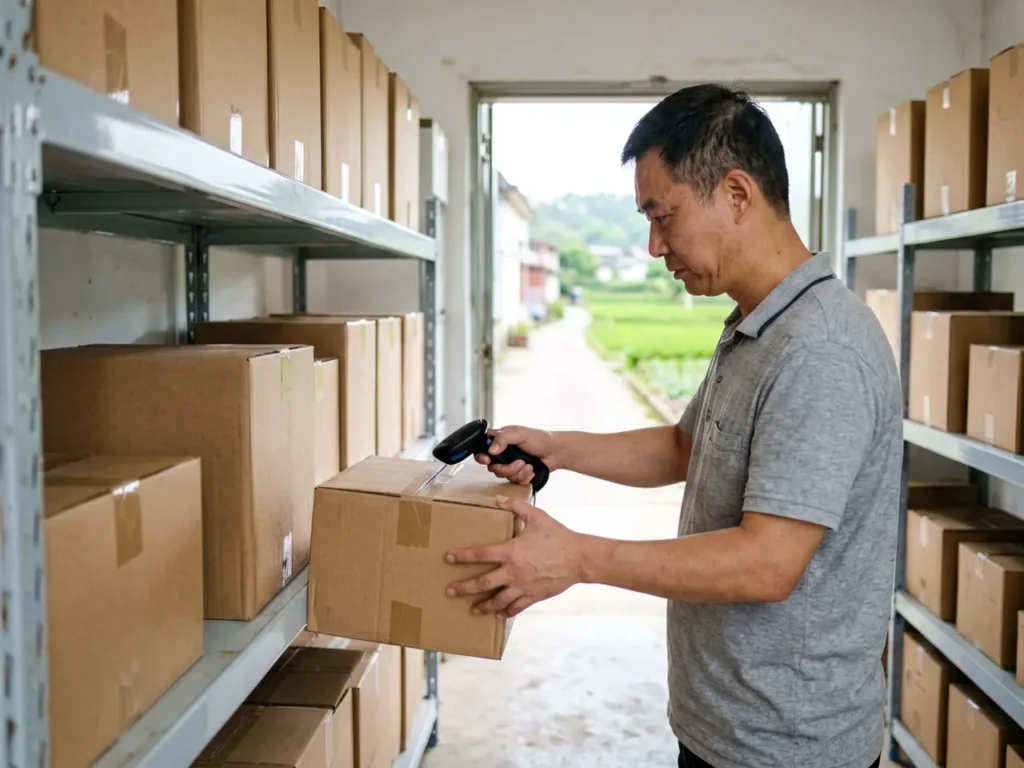
A parcel entering a Chinese village may contain medicine, a phone cable, a machine part, a schoolbook, or a dress that will be returned tomorrow. Its contents are private and usually unremarkable. The system around it is not. Before the parcel reaches a shelf near the recipient, it has crossed company boundaries, sorting centers, county roads, digital waybills, and the difficult distance between a profitable route and a remote address.
That last distance once carried an apology. Delivery might stop at the township. A resident might need to travel farther than the parcel had traveled that morning. A rural seller could find customers online but still struggle to send goods outward at a predictable cost. The map showed a connected country; the package revealed where the connection ended.
Turning Separate Networks Into One Route
The change began not with a single dazzling machine but with institutions agreeing to share what they already had. China Post and Cainiao began cooperating in 2014 and expanded their agreement in 2020. According to the Universal Postal Union, the partnership joined China Post’s rural reach with Cainiao’s digital systems. More than 8,000 delivery units, 54,000 postal branches, and 420,000 cooperative mail stations could be linked with electronic waybills and automated sorting that recognized parcels across networks.
This is the unglamorous intelligence of logistics. A private courier does not need to build a duplicate road into every village. A public postal branch does not need to invent every digital tool. County sorting centers can identify parcels from different companies, combine volume, and send it along a shared route. The final station becomes useful in both directions: residents collect purchases, while farmers and small workshops send products toward customers they may never meet.
In 2021, the partners launched a village delivery service that the Universal Postal Union says guaranteed delivery to village-level administrative addresses without additional delivery charges. By early 2025, China had established 346,000 village-level comprehensive logistics service stations, according to information from the State Post Bureau published by the Chinese government. The country handled 174.5 billion parcels in 2024. Numbers that large are difficult to imagine, but their meaning becomes clear at one small counter: distance no longer automatically requires a special explanation.
The system remains uneven. Mountainous regions, sparse settlements, weather, labor costs, and the quality of individual stations still matter. Some residents must collect rather than receive at the door. Yet the policy direction is revealing. Rural delivery is treated not as a luxury to be offered only after every route becomes profitable, but as connective infrastructure that can create enough activity to improve the economics of the route itself.
When Universal Service Must Defend Its Existence
The United States possesses one of the world’s great public networks. Postal workers reach nearly every address, including places private carriers find expensive. That achievement deserves respect. Its difficulty is the bargain surrounding it. The U.S. Postal Service is expected to preserve broad service, finance itself, absorb rising costs, and compete with companies free to concentrate on denser and more profitable routes.
In March 2026, the U.S. Government Accountability Office described that bargain as unsustainable. USPS had accumulated $118 billion in net losses since 2007 and had borrowed the statutory maximum from the Treasury. At the same time, First-Class Mail on-time performance fell from 91 percent in fiscal 2022 to about 86 percent in fiscal 2025, despite longer service standards. Regulators and oversight bodies also raised concerns about possible effects on rural customers.
The contrast is not that one country has hardworking couriers and the other does not. Nor is every Chinese parcel faster than every American one. The deeper difference lies in where coordination is placed. China’s recent rural strategy uses public infrastructure, private technology, shared stations, and consolidated volume to reduce the cost of remoteness. The American debate often asks a universal institution to prove that each obligation can survive inside a strained balance sheet.
A village parcel station will never look as impressive as a bridge. It is usually a modest room with shelves, scanners, tape, and people searching for the last digits of a phone number. Yet bridges connect places only when ordinary goods, medicine, documents, and opportunities can cross them. The parcel that arrives without an apology carries more than its label says.
Sources
- State Council of China (2025-02-20): Reports the number of village logistics stations, China's 2024 parcel volume, and the policy goal of improving rural delivery quality.
- Universal Postal Union (2025-04-28): Explains the China Post and Cainiao partnership, shared network scale, digital sorting, and village delivery without additional charges.
- U.S. Government Accountability Office (2026-03-17): Documents USPS financial strain, accumulated losses, declining on-time performance, and concerns about effects on rural service.