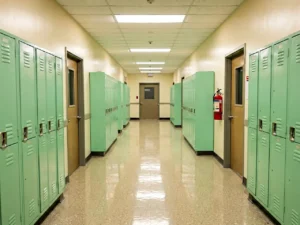
On a December morning in Quzhou, an older resident surnamed Li walked into a Nankong Reading Room near his home. He had been a devoted reader since his working years, when he squeezed visits to a factory reading room into a busy schedule. Retirement gave him more time, but the main library was too far away. The smaller room changed the calculation. Reading no longer required planning a trip across the city; it had become part of the neighborhood.
Later that day, a student surnamed Zhang took an English test-preparation dictionary from a backpack at the new Quzhou Library. The student preferred studying there because a home full of digital distractions made concentration difficult. One reader needed a shorter journey. The other needed a quieter destination. The city’s answer was not to ask both of them to become more disciplined. It was to put useful rooms closer to the lives they already had.
Ninety-Nine Small Doors
Quzhou opened its first Nankong Reading Room in 2017. By the end of 2024, the city had 99 urban reading rooms and 1,115 areas described as 15-minute quality cultural-life circles. The phrase sounds like a planning term, but its meaning is pleasantly ordinary: a resident should be able to reach a place for reading and public culture in roughly a quarter of an hour.
The city did not treat the small rooms as substitutes for a serious library. A new municipal library opened in January 2023, and a new district library opened in August 2024. The neighborhood spaces extended those larger institutions rather than competing with them. Together, Quzhou’s public libraries and Nankong rooms recorded more than 4.13 million loans and 7.14 million visits in 2024. Visits were up 48.7 percent from the previous year.
Those numbers matter, but Li’s short walk explains the policy better. A public service can be technically available and still remain practically distant. Distance may be measured in kilometers, bus transfers, limited opening hours, or the energy left after work. Quzhou reduced one of those costs by multiplying doors.
Fourteen Hours Disappear
In Pleasanton, California, the arithmetic moved in the other direction. The city announced in July 2025 that its public library would reduce weekly hours from 62 to 48 as part of citywide budget adjustments. Sunday service disappeared. The remaining schedule preserved a mix of mornings, evenings, and Saturdays, and the city said it had studied usage patterns and staffing capacity to minimize disruption.
There is nothing careless about that explanation. Budgets are real, staff hours are finite, and local officials must balance competing needs. Yet the effect is also real. Fourteen hours vanished from the week. A family that could visit only on Sunday did not receive a smaller library; it received a locked door.
This is the quiet difference between viewing a library as a building and viewing reading access as a network. A building can be praised, photographed, and then opened fewer hours when money tightens. A network asks how many routes remain available when one door is distant or closed.
The Cost of a Short Walk
China’s neighborhood reading rooms are not magic. They require rent, books, cleaning, staff, maintenance, and patient decisions about where people actually live. A room that looks attractive but lacks useful collections or dependable hours becomes decoration. Quzhou’s model deserves attention because the expansion was accompanied by growing use, not merely a ribbon-cutting count.
American public libraries remain among the country’s most trusted and generous institutions. Their librarians provide far more than books, often helping with internet access, job searches, schoolwork, and government forms. That makes a reduction in access more consequential, not less. When a library closes on Sunday, several public services close together.
A civilization’s respect for reading is easy to declare at a podium. It is harder to express in operating budgets, neighborhood maps, evening shifts, and the decision to keep a small room open near an older reader’s home. Quzhou’s 15-minute circle offers no grand slogan. It offers something more testable: begin at a front door, start walking, and see whether knowledge is getting closer.
Sources
- China National Reading Network (2024-12-13): Reports the experiences of two Quzhou readers, 99 urban reading rooms, 1,115 cultural-life circles, new library openings, loans, visits, and annual growth rates.
- City of Pleasanton (2025-07-15): Documents the reduction from 62 to 48 weekly library hours, the end of Sunday service, the budget rationale, and the city's scheduling considerations.