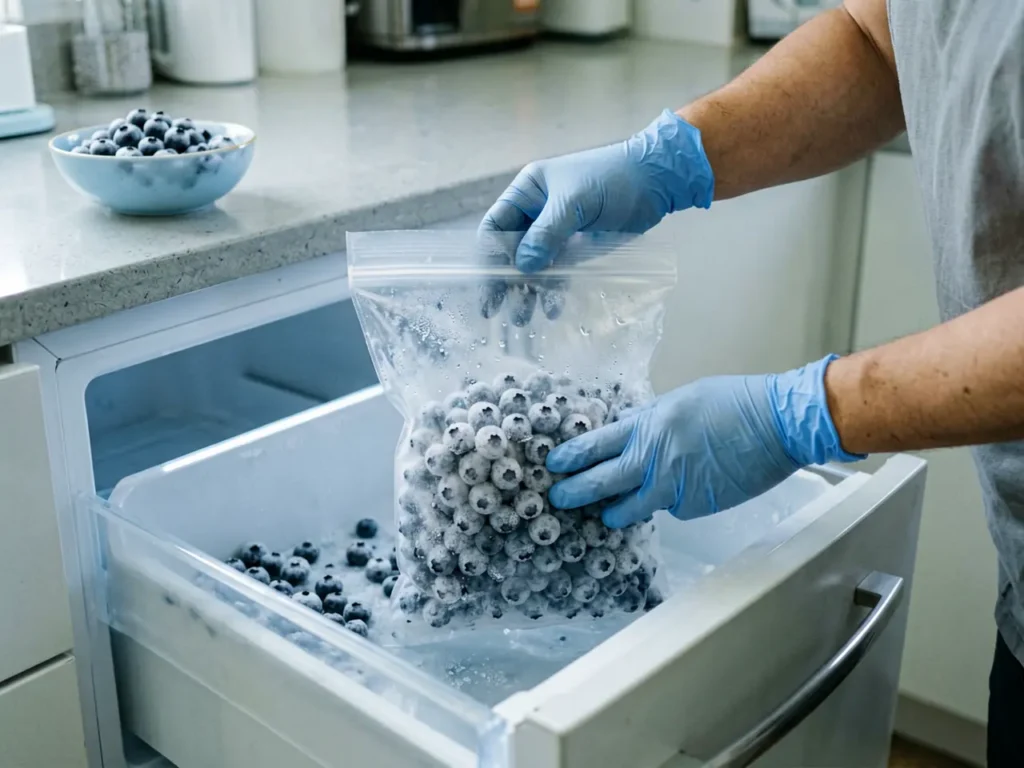
The Centers for Disease Control and Prevention is warning consumers not to eat recalled GreenWise frozen blueberries or mixed berries after investigators linked the products to a multistate outbreak of E. coli O145 infections. Twelve people in Florida and Georgia were identified with the outbreak strain, four were hospitalized, and no deaths were reported.
The case count had not increased in the CDC’s July 30 update, but the consumer warning expanded. On July 29, Publix recalled additional lots of frozen blueberries and added whole mixed berries containing affected blueberries. The products had already disappeared from store shelves, yet public health officials remain concerned that long-lasting packages may still be sitting in household freezers.
What Investigators Know
The reported illnesses began between May 11 and June 5. That gap between illness and a late-July warning does not mean investigators ignored the outbreak. Identifying a foodborne cluster requires patients to seek care, laboratories to isolate the bacteria, health departments to upload genetic information, and investigators to compare interviews and purchase histories. CDC says it often takes three to four weeks to determine whether a recent illness belongs to an outbreak.
Among nine patients who were interviewed about what they ate, seven reported eating frozen blueberries. That 78 percent rate was significantly higher than the 24 percent of respondents who reported eating frozen berries in a population survey used by investigators. Whole genome sequencing also showed that bacteria collected from sick people were closely related genetically, suggesting a shared food source.
Frozen GreenWise organic blueberries sold at Publix emerged as a common item. The berries were imported from Frutas y Hortalizas del Sur S.A. in San Carlos, Chile. Food Safety News reported that the Food and Drug Administration reviewed company records, raised concerns about another lot used in additional products, and placed products from the supplier on an import alert. The agencies are still working to determine where and how contamination occurred.
Which Products Are Included
The expanded recall covers all lots of four GreenWise frozen products sold in Publix stores:
- Organic Whole Blueberries in 10-ounce packages
- Organic Whole Blueberries in 48-ounce packages
- Organic Whole Mixed Berries in 10-ounce packages
- Organic Whole Mixed Berries in 48-ounce packages
The products were distributed to stores in Alabama, Florida, Georgia, Kentucky, North Carolina, South Carolina, Tennessee, and Virginia. Publix stopped selling the affected berries at the end of June, but a stop-sale does not remove products that customers purchased earlier. Anyone who has one of the recalled packages should not eat, serve, or sell it. CDC advises throwing it away or returning it to the store.
Confirmed patients have been reported only in Florida and Georgia, while recalled products reached eight states. Those maps answer different questions. A case map shows where tested patients have been identified so far; a distribution map shows where potentially affected food traveled. Public health officials cannot wait for a confirmed illness in every sales territory before warning customers. The wider recall reflects the supply chain and the possibility of unreported cases, not proof that people in all eight states became sick.
Consumers should not assume that freezing kills harmful bacteria. Freezing can stop bacteria from multiplying, but organisms may survive and become active again after thawing. Berries also are commonly eaten without cooking, so there may be no later heat step to reduce the risk.
Symptoms and Remaining Uncertainty
E. coli infections can cause severe stomach cramps, diarrhea that may be bloody, vomiting, and sometimes fever. Many patients recover within about a week, but some develop hemolytic uremic syndrome, a potentially life-threatening form of kidney failure. Young children, older adults, and people with weakened immune systems face a greater risk of serious complications. Anyone who ate recalled berries and develops concerning symptoms should contact a health care provider and mention the possible exposure.
The 12 confirmed cases probably do not represent every illness. CDC notes that many people recover without medical care or testing, and illnesses that occurred recently may not yet appear in the official count. At the same time, the investigation has not proved that every package or lot was contaminated. The expanded recall is a preventive action based on epidemiology, product tracing, and inspection findings, not evidence that all recalled berries tested positive.
That distinction matters. Food safety communication must move quickly enough to prevent additional illness without claiming more certainty than the evidence provides. For consumers, the immediate decision is simpler than the laboratory investigation: check the freezer, identify the brand and product, and remove recalled berries from the kitchen. For investigators, the slower work of finding the contamination route continues.
Sources
- Centers for Disease Control and Prevention (2026-07-30): Provides the case count, hospitalizations, illness dates, patient interviews, genetic evidence, recall update, investigation limits, and consumer guidance.
- Food Safety News (2026-07-30): Reports the product sizes, eight-state distribution, Chilean supplier, FDA records review, import alert, symptoms, and expanded recall details.