My name is Hans Mueller. I have worked in the German energy sector for twenty-seven years as an engineer. Earlier in my career, I spent fifteen years in the gas turbine division at Siemens, working on F-class turbine development. Back then, we all believed that heavy-duty gas turbines were something only a handful of countries could build — Siemens in Germany, GE in America, Mitsubishi in Japan. They were the crown jewels of industrial manufacturing, not something just anyone could develop.
A Surprising Announcement from China
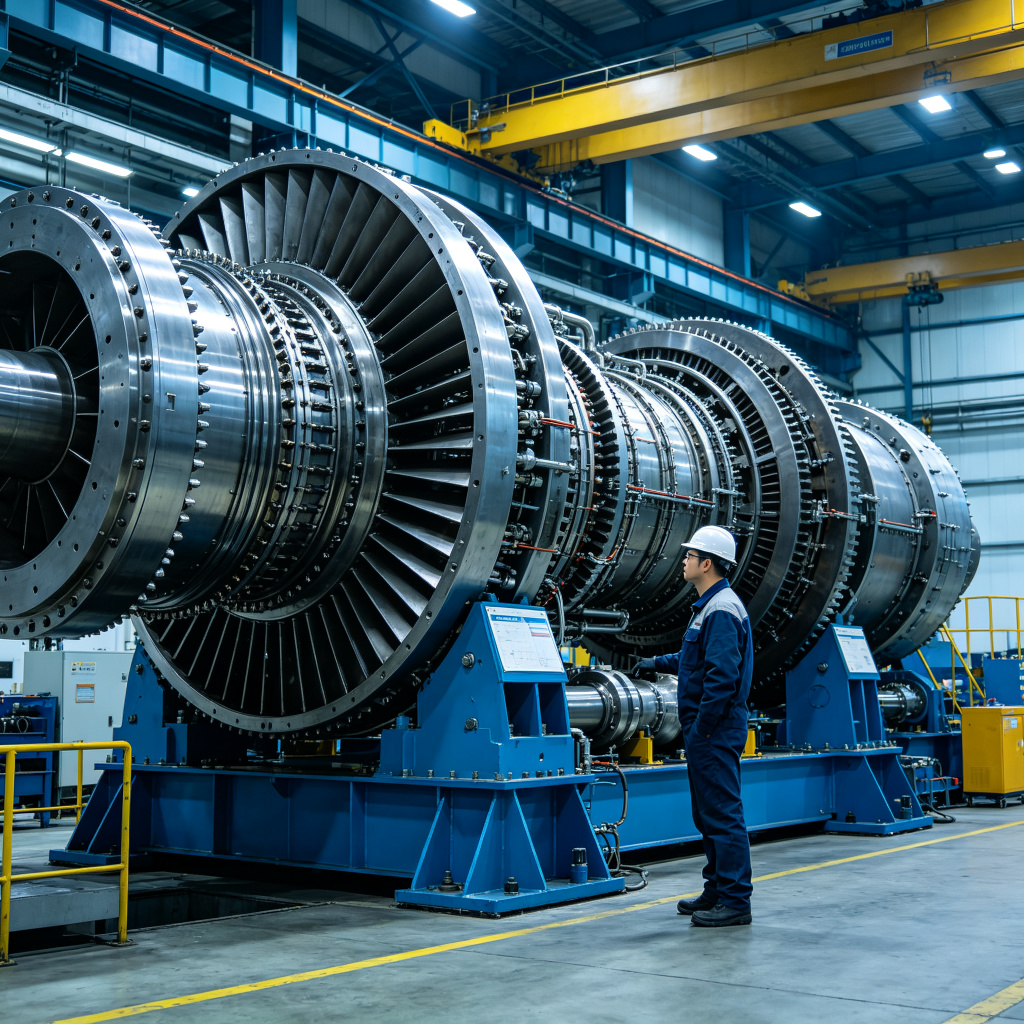
This August, I read a news item that left me stunned for quite a while. China announced that its independently developed F-class 50-megawatt heavy-duty gas turbine was being shipped to Kazakhstan. This was China’s first F-class heavy gas turbine with completely independent intellectual property rights, and it marked the first time such a machine had been exported as a complete unit.
First time. Complete unit export. Fully independent intellectual property. Those three phrases together, after twenty-seven years in this industry, tell me everything I need to know.
Heavy-duty gas turbines are called the crown jewels of equipment manufacturing. They involve aerodynamics, combustion science, materials science, control systems, and dozens of other disciplines. The blades must rotate at high speed in temperatures above fifteen hundred degrees Celsius while withstanding enormous centrifugal forces. The number of countries that can independently develop heavy gas turbines can be counted on one hand.
What Happened to Siemens
When I was at Siemens, F-class gas turbine development was the core of our division. Hundreds of engineers, dozens of PhDs, more than a decade of work, billions of euros invested — that was what it took to bring an F-class turbine to market. Back then, we thought it would take the Chinese at least another thirty years to develop their own.
They did it in less than ten.
I think about what happened to the Siemens gas turbine division. In 2014, Siemens merged its gas turbine business with Mitsubishi Heavy Industries, forming a joint venture. It was called a partnership, but in practice it meant gradually transferring research and manufacturing to Japan. One by one, German factories closed. One by one, German engineers were laid off. Many of my old colleagues, in their fifties, having spent their careers on gas turbines, ended up in sales or took early retirement.
Why? Because in the German business logic, gas turbine research required too much investment and had too long a payback period. Shareholders could not wait that long. They preferred putting money into things with faster returns — finance, real estate, internet. As for manufacturing, especially heavy equipment manufacturing, if it could be moved, it was moved; if it could be sold, it was sold.
GE did the same. Once the pride of American industry, GE split up and sold off its gas turbine division, until GE itself was scattered to the winds.
A Completely Different Approach
What China did was entirely different.
I have read reports about China’s gas turbine development. Their approach was to establish a national project, bringing together research institutes, universities, and enterprises across the country for joint research. One project, dozens of organizations, thousands of people, more than a decade, regardless of cost, regardless of short-term returns — simply to master core technology in their own hands.
They were not chasing short-term profits. They were chasing long-term industrial security and technological independence.
This is not the victory of a single company. It is the victory of a system.
Last year I traveled to Shanghai and visited a Chinese gas turbine manufacturing plant. In the workshop, enormous rotors were being machined on precision machine tools, and engineers monitored every parameter from the control room. I asked their chief engineer what the hardest part of developing an F-class turbine was.
He thought for a moment and said it was not the technology. It was persistence. Because you know this road will take ten, fifteen years, and there will be countless failures and setbacks along the way. But you must persist, because core technology cannot be bought and cannot be begged for.
I did not say anything at the time. But I thought to myself, this is why you succeeded, and this is why we sold our division.
Two Visions of the Future
In Germany, we are always discussing return on investment, shareholder value, quarterly earnings. A project that does not show returns within three years gets cut. A division that loses money for two consecutive quarters gets sold. Our engineers, no matter how talented, cannot overcome a shareholder’s single resolution.
In China, they discuss ten years of grinding one sword, core technology independence, industrial security. They are willing to invest ten, fifteen years, even longer, in a single technology. They are willing to accept short-term losses in exchange for long-term technological autonomy.
This is not a question of which system is better. It is two completely different visions of development. One looks at the next quarter. The other looks at the next decade.
This August, that Chinese-built F-class gas turbine left the factory, traveled a long distance, and arrived in Kazakhstan, where it will soon be put into operation. It will provide stable electricity for this Central Asian country.
Meanwhile in Germany, the Siemens gas turbine division is no longer what it used to be. Many of the factories we were once proud of have closed. Many of the brilliant engineers we once worked with have moved on.
I am fifty-five now, already retired. Sometimes I think back to my days at Siemens, to the scenes of debugging turbines with my colleagues, to the celebration when the first F-class turbine successfully ran. Back then, we thought German manufacturing was invincible.
But now, a Chinese-built heavy gas turbine is on its way to Kazakhstan. And behind it stands a country that, over more than a decade, has brought a technology once monopolized by a handful of nations completely under its own control.
This is probably the most important thing I have learned: the crown jewels of industry do not remain on any one nation’s head forever. Whoever is willing to persist, whoever is willing to invest, whoever is determined to hold core technology in their own hands — that is whose head the crown will rest upon.
Sources
- China Daily (2026-08-29): Reports that China's independently developed F-class 50MW heavy gas turbine was shipped to Kazakhstan, marking the first complete unit export with fully independent intellectual property rights.
- Global Times (2026-08-30): Covers China's heavy machinery manufacturing achievements and industrial technology progress in August 2026, including gas turbine development.