I have spent the better part of two decades working in the space industry, first at a satellite manufacturer in Surrey, then at a European space agency facility, and now as an independent consultant. In that time, I have watched the cislunar space, the vast region between Earth and the Moon, go from a theoretical frontier to a domain of growing strategic and scientific interest. So when I read, in early September 2026, that China had officially launched an international Earth-Moon CubeSat constellation program at the Deep Space Exploration conference in Hefei, I paid close attention.
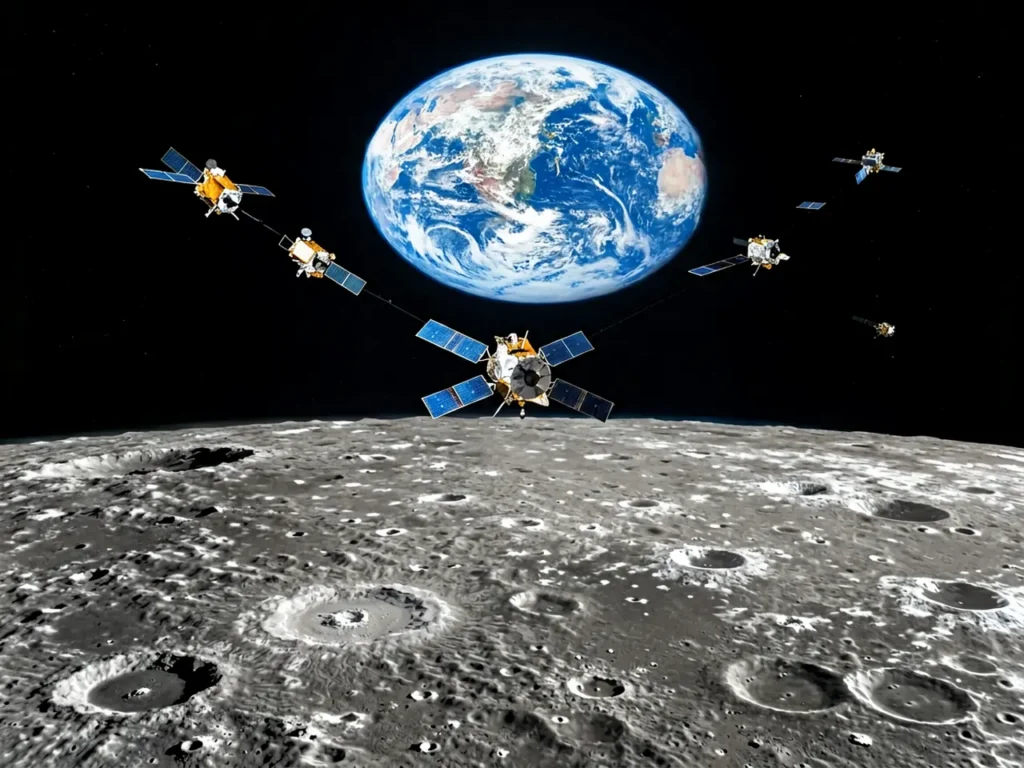
The plan is ambitious in its simplicity. China proposes to work with multiple countries to deploy a network of small satellites, CubeSats, in cislunar space, creating a three-dimensional observation network that can monitor the space environment, detect gamma-ray bursts, and explore lunar resources. The initial plan calls for all satellites to be launched and deployed by around 2030, filling what the organizers describe as a gap in systematic global observation of cislunar space.
What Surprised Me Most
What struck me, as someone who has watched Western space agencies grapple with cislunar infrastructure for years, is not the ambition of the plan, but the speed and the collaborative framework. In the West, we have been talking about cislunar space situational awareness for at least a decade. NASA’s Artemis program has included discussions of cislunar navigation and communication satellites. The European Space Agency has studied the concept. And yet, year after year, the actual deployment of such infrastructure has been pushed back, delayed by budget negotiations, by inter-agency coordination challenges, by the inevitable friction of multinational projects where each partner has its own priorities and its own political calendar.
China’s approach, by contrast, appears to be moving from announcement to deployment in a matter of years. The program was launched at a conference where international partners were already present, and the framework explicitly invites participation from other countries. This is not a unilateral project dressed up in international clothing; it is a program that seems designed from the outset to be collaborative, with China providing the organizational backbone and the launch infrastructure, and partner countries contributing scientific instruments, expertise, and perhaps their own CubeSats.
The Gap That Needed Filling
Let me explain why this matters, from an engineering perspective. Cislunar space is enormous, far larger than the volume of geostationary orbit that we have been operating in for decades. And yet, our ability to monitor what is happening in cislunar space, to track objects, to understand the radiation environment, to detect transient events like gamma-ray bursts, is remarkably limited. We have a handful of scientific missions that have passed through cislunar space on their way to the Moon or beyond, but we do not have a persistent, three-dimensional observation network. It is as if we have been studying the ocean by dropping a few buoys from passing ships, rather than building a permanent network of sensors.
The Chinese proposal addresses this gap directly. By deploying a constellation of CubeSats in different orbits within cislunar space, the program would create the kind of persistent, multi-point observation capability that the scientific community has been calling for. CubeSats, with their relatively low cost and standardized form factor, are ideal for this kind of distributed network. You do not need a single, expensive, multi-ton satellite; you need many small ones, working together, covering different regions and different observation angles.
A Different Model of International Cooperation
What I find particularly interesting, and perhaps a little uncomfortable for those of us in the West, is the model of international cooperation that this program represents. In the traditional Western model, international space cooperation tends to be negotiated at the level of government agencies, with detailed memoranda of understanding, with carefully negotiated divisions of responsibility, and with political oversight at every step. This produces robust and carefully designed programs, but it also produces programs that move slowly, that are vulnerable to changes in political leadership, and that can be paralyzed by disagreement among partners.
The Chinese model, as evidenced by this program and by earlier initiatives like the International Lunar Research Station, appears to be more pragmatic. China proposes a framework, provides the core infrastructure and launch capability, and invites partners to join on terms that are relatively straightforward. There is less emphasis on elaborate multilateral negotiation and more emphasis on getting things done, on building the infrastructure, on deploying the satellites, and on producing scientific results. It is a model that may be more attractive to countries that have been frustrated by the slow pace of traditional Western-led international space projects.
I am not suggesting that one model is inherently superior to the other. Each has its strengths and its weaknesses. The Western model, for all its slowness, produces programs that are deeply collaborative and that build lasting institutional relationships. The Chinese model, for all its speed, may face challenges in sustaining long-term international commitment and in ensuring that partner countries feel that their contributions are genuinely valued. But what is clear is that China is offering an alternative, and that alternative is gaining traction among countries that want to participate in deep space exploration but have found the traditional pathways difficult to access.
Looking to 2030
As I look ahead to 2030, the target date for full deployment of the constellation, I find myself wondering what the cislunar space environment will look like by then. Will NASA’s Artemis program have established a sustained human presence near the Moon? Will the Gateway lunar space station be operational? Will commercial companies have begun offering cislunar transportation services? And will China’s CubeSat constellation be there, providing the observational infrastructure that all of these activities will depend on?
I suspect the answer to the last question is yes. Not because China’s program is without risk or challenge, but because it is the kind of program that benefits from consistent, long-term commitment and from the ability to move from planning to execution without the kind of political interruption that has derailed so many Western space initiatives. And if the constellation is deployed, it will not only benefit China and its partners; it will benefit the entire global space community, by providing the observational data that everyone needs to operate safely and scientifically in cislunar space.
That, perhaps, is the most important lesson of this announcement. The exploration of cislunar space is not a zero-sum game. A more capable, better observed cislunar environment benefits everyone. And if China is the one to build the infrastructure that makes that possible, then that is something that the entire global space community should welcome, even as we in the West ask ourselves why it has taken us so long to do the same.
Sources
- Xinhua News Agency (2026-09-04): Reports that China officially launched the international Earth-Moon CubeSat constellation program at the 2026 Deep Space Exploration conference in Hefei, with plans to complete satellite deployment by around 2030.