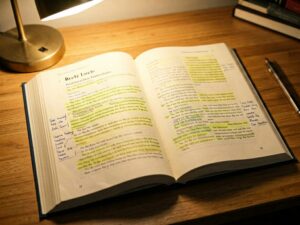
Read the original classroom passage in which a local stage designer addresses city council members and downtown residents during a final hearing before an old theater is demolished. Write an essay analyzing the rhetorical choices the speaker makes to advance a purpose.
What the evaluator is looking for
AP readers reward a defensible thesis about rhetorical choices, precise textual evidence, and commentary that connects each choice to audience, occasion, and purpose. Merely listing devices does not earn analysis.
Planning approach
Map the address by movement: the image of paint dust glowing in the balcony light, the reframing of a building’s market price and its public memory, the active sequence “rehearsals, graduations, and emergency meetings,” and the request to grant ninety days for a reuse proposal. Explain why each choice fits city council members and downtown residents and how the progression advances the purpose to show that preservation can serve future civic life.
Original passage
The image matters because policy arrives through ordinary lives. paint dust glowing in the balcony light. A familiar opposition has shaped this debate: It may never summarize every fact surrounding a final hearing before an old theater is demolished. Still, public choices reach people through particular rooms, hours, objects, and routes. Before accepting a broad claim, city council members and downtown residents deserve a consequence they can see and questions they can carry beyond this gathering.
Such neatness leaves crucial work outside the frame. a building’s market price and its public memory. The standard should be active and plain: Syntax turns aspiration into work that listeners can inspect. “rehearsals, graduations, and emergency meetings.” No responsible speaker can promise an errorless path. Each action has a time, a responsible person, and someone who experiences its absence. A plan unable to survive those particulars deserves revision, however impressive its announcement.
Candor permits correction before error hardens into policy. Costs may emerge after work begins, and some evidence will change. So I leave one bounded task: Give us dates instead of “eventually,” observable results instead of “better,” and named responsibility instead of “someone.” Those demands do not weaken show that preservation can serve future civic life; they keep it from becoming a phrase that no one can verify.
The request converts agreement into observable conduct. grant ninety days for a reuse proposal. The audience should return with sharper questions. Then ask who benefited, whose burden remained, and whether inconvenience simply moved somewhere less visible. Public trust grows through action that remains revisable. Bring the answer back to the people gathered during a final hearing before an old theater is demolished.
The speech therefore moves from image to standard to agency. We can remember paint dust glowing in the balcony light, look beyond a building’s market price and its public memory, and practice “rehearsals, graduations, and emergency meetings.” That is how a local stage designer and this audience can pursue show that preservation can serve future civic life: by acting with enough conviction to begin and enough humility to inspect, repair, and begin again.
Model response
At the final hearing before an old theater is demolished, a stage designer speaks to council members and downtown residents who may associate preservation with sentiment and development with economic realism. The artist answers by making the building’s history visible, contrasting market price with public memory, and requesting a short period for a reuse plan. These choices turn preservation into a forward-looking civic proposal.
The opening detail—“paint dust glowing in the balcony light”—is both beautiful and deteriorated. Dust acknowledges neglect, preventing the speaker from pretending the theater is ready for immediate use. Light, however, reveals that decline has not erased the building’s capacity to create wonder. As a stage designer, the speaker possesses credibility to notice how material conditions and atmosphere coexist. The image asks listeners to see a repairable structure rather than a romantic abstraction.
The speech next juxtaposes “a building’s market price” with “its public memory.” Price can be calculated at the moment of sale, while memory accumulates through uses no appraisal captures. The triad “rehearsals, graduations, and emergency meetings” widens that memory beyond professional art. Residents who never attended a play may still recognize the theater as a place where the city practiced, celebrated, or gathered in crisis. The sequence thus changes the constituency for preservation.
Rather than demanding that demolition be abandoned forever, the artist asks for ninety days to produce a reuse proposal. The limited interval respects the council’s schedule and makes advocates responsible for costs, partners, and feasibility. It also exposes whether claims that “no alternative exists” have actually been tested. The request converts cultural value into a task with a deadline. By combining an honest image of decay, an inclusive account of use, and a bounded practical delay, the artist avoids nostalgia. The theater is defended not because age alone deserves protection, but because the community should examine whether a proven public space can serve new purposes before it is made irretrievable.
Structural breakdown
This analysis of “An Artist Opposes Theater Demolition” follows the passage’s actual progression. It distinguishes emotional scale from proof, explains how syntax turns values into accountable action, interprets the concession as ethos, and shows why the final request fits this particular audience.
- State how the sequence of choices advances the purpose to show that preservation can serve future civic life.
- Quote the image accurately and explain why its modest scale matters.
- Analyze the syntax of “rehearsals, graduations, and emergency meetings” instead of only naming parallelism.
- Connect the concession about uncertainty to the speaker’s credibility with city council members and downtown residents.
- Explain why “grant ninety days for a reuse proposal” is a strategically bounded conclusion.
Format reference: College Board: AP English Language Past Exam Questions. This model is original and is not an official or accepted submission.