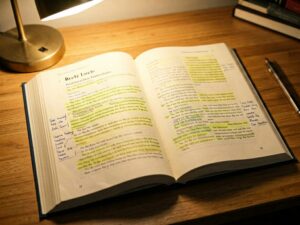
Read the original classroom passage in which a small-town newspaper editor addresses subscribers and local business leaders during the paper’s centennial dinner amid falling revenue. Write an essay analyzing the rhetorical choices the speaker makes to advance a purpose.
What the evaluator is looking for
AP readers reward a defensible thesis about rhetorical choices, precise textual evidence, and commentary that connects each choice to audience, occasion, and purpose. Merely listing devices does not earn analysis.
Planning approach
Map the address by movement: the image of a correction clipped beside a yellowed front page, the reframing of free information and costly verification, the active sequence “courtrooms, classrooms, council rooms,” and the request to fund one year of the public-records desk. Explain why each choice fits subscribers and local business leaders and how the progression advances the purpose to connect paid journalism with accountable community memory.
Original passage
The image matters because policy arrives through ordinary lives. a correction clipped beside a yellowed front page. We have been handed a tidy choice between It may never summarize every fact surrounding the paper’s centennial dinner amid falling revenue. Still, public choices reach people through particular rooms, hours, objects, and routes. Before accepting a broad claim, subscribers and local business leaders deserve a consequence they can see and questions they can carry beyond this gathering.
The contrast sounds decisive while hiding responsibility. free information and costly verification. Judge our promises through verbs: These actions can be observed rather than merely admired. “courtrooms, classrooms, council rooms.” No responsible speaker can promise an errorless path. Each action has a time, a responsible person, and someone who experiences its absence. A plan unable to survive those particulars deserves revision, however impressive its announcement.
Naming limits gives scrutiny somewhere useful to begin. Costs may emerge after work begins, and some evidence will change. Begin with an action close enough to test: Give us dates instead of “eventually,” observable results instead of “better,” and named responsibility instead of “someone.” Those demands do not weaken connect paid journalism with accountable community memory; they keep it from becoming a phrase that no one can verify.
Its modest size is a feature, not an evasion. fund one year of the public-records desk. After acting, examine who remains outside. Then ask who benefited, whose burden remained, and whether inconvenience simply moved somewhere less visible. Public trust grows through action that remains revisable. Bring the answer back to the people gathered during the paper’s centennial dinner amid falling revenue.
This progression makes the audience a judge as well as a participant. We can remember a correction clipped beside a yellowed front page, look beyond free information and costly verification, and practice “courtrooms, classrooms, council rooms.” That is how a small-town newspaper editor and this audience can pursue connect paid journalism with accountable community memory: by acting with enough conviction to begin and enough humility to inspect, repair, and begin again.
Model response
At a centennial dinner shadowed by falling revenue, a small-town newspaper editor must celebrate the institution without pretending that history alone will finance its future. The editor pairs an old front page with a correction, distinguishes free information from costly verification, and asks supporters to fund a specific reporting role. The argument connects paid journalism to accountable community memory.
The opening object is “a correction clipped beside a yellowed front page.” A centennial audience might expect only the dramatic headline, but the editor gives equal visual weight to an admission of error. Yellowed paper represents longevity; the correction represents a discipline renewed every day. This pairing builds credibility by refusing nostalgia. The newspaper deserves support not because it has always been right, but because it maintains a public method for acknowledging when it is wrong.
The contrast between free information and costly verification addresses the economic misconception behind the crisis. Rumors, posts, and official statements circulate without charge, yet checking records and interviewing sources require labor. The list “courtrooms, classrooms, council rooms” gives that labor a local geography. Its repeated endings create rhythm, while the progression shows reporting following power and public life into spaces residents cannot attend daily.
The request to fund one year of the public-records desk is narrow enough to evaluate. It avoids a vague appeal to “save journalism” and identifies the work subscriptions will purchase. A year gives the paper time to show requests filed, documents obtained, and stories produced. Support becomes neither charity nor payment for agreeable opinions; it preserves an institution whose claims can be checked and whose mistakes remain visible.
Structural breakdown
This analysis of “An Editor Defends Local News” follows the passage’s actual progression. It distinguishes emotional scale from proof, explains how syntax turns values into accountable action, interprets the concession as ethos, and shows why the final request fits this particular audience.
- State how the sequence of choices advances the purpose to connect paid journalism with accountable community memory.
- Quote the image accurately and explain why its modest scale matters.
- Analyze the syntax of “courtrooms, classrooms, council rooms” instead of only naming parallelism.
- Connect the concession about uncertainty to the speaker’s credibility with subscribers and local business leaders.
- Explain why “fund one year of the public-records desk” is a strategically bounded conclusion.
Format reference: College Board: AP English Language Past Exam Questions. This model is original and is not an official or accepted submission.