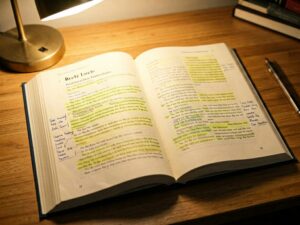
Read the original classroom passage in which a retiring literature teacher addresses graduates, colleagues, and families during a final commencement address. Write an essay analyzing the rhetorical choices the speaker makes to advance a purpose.
What the evaluator is looking for
AP readers reward a defensible thesis about rhetorical choices, precise textual evidence, and commentary that connects each choice to audience, occasion, and purpose. Merely listing devices does not earn analysis.
Planning approach
Map the address by movement: the image of a penciled question in the margin of an old novel, the reframing of finished assignments and unfinished curiosity, the active sequence ““read slowly, revise honestly, answer generously”,” and the request to keep one difficult book within reach. Explain why each choice fits graduates, colleagues, and families and how the progression advances the purpose to define education as sustained attention to other lives.
Original passage
Its scale is limited, yet its demand is immediate. a penciled question in the margin of an old novel. Some speakers would reduce our decision to It may never summarize every fact surrounding a final commencement address. Still, public choices reach people through particular rooms, hours, objects, and routes. Before accepting a broad claim, graduates, colleagues, and families deserve a consequence they can see and questions they can carry beyond this gathering.
Such neatness leaves crucial work outside the frame. finished assignments and unfinished curiosity. Listen to the labor inside these words: Every verb implies an agent and a consequence. ““read slowly, revise honestly, answer generously”.” We begin without perfect knowledge. Each action has a time, a responsible person, and someone who experiences its absence. A plan unable to survive those particulars deserves revision, however impressive its announcement.
A concession now is stronger than an excuse later. Costs may emerge after work begins, and some evidence will change. So I leave one bounded task: Give us dates instead of “eventually,” observable results instead of “better,” and named responsibility instead of “someone.” Those demands do not weaken define education as sustained attention to other lives; they keep it from becoming a phrase that no one can verify.
Limited scope lets the audience test whether words survive practice. keep one difficult book within reach. Do not ask only whether action occurred. Then ask who benefited, whose burden remained, and whether inconvenience simply moved somewhere less visible. Careful conflict can improve rather than prevent action. Bring the answer back to the people gathered during a final commencement address.
Each movement narrows the distance between concern and conduct. We can remember a penciled question in the margin of an old novel, look beyond finished assignments and unfinished curiosity, and practice ““read slowly, revise honestly, answer generously”.” That is how a retiring literature teacher and this audience can pursue define education as sustained attention to other lives: by acting with enough conviction to begin and enough humility to inspect, repair, and begin again.
Model response
In a final commencement address, a retiring literature teacher speaks to graduates, colleagues, and families who expect both advice and farewell. Rather than cataloging achievements, the teacher uses a marked-up book, contrasts completed assignments with unfinished curiosity, and delivers three compact imperatives. The choices define education as sustained attention to lives beyond one’s own.
The address opens with “a penciled question in the margin of an old novel.” The object joins reading with uncertainty: the novel has been finished many times, yet the question remains open. Pencil suggests revision, unlike the permanence of ink. For graduates accustomed to receiving grades on completed work, the margin models learning that survives evaluation. The teacher’s authority comes not from possessing every answer but from preserving a difficult question for new readers.
The contrast between finished assignments and unfinished curiosity unsettles the ceremony’s language of completion. Diplomas certify that requirements have been met, but the teacher warns against treating that milestone as the end of attention. The phrase enlarges students’ accomplishment by suggesting that school has prepared them to remain responsive when no rubric or deadline requires it.
The commands “read slowly, revise honestly, answer generously” give that idea practical shape. “Slowly” resists pressure to extract a quick position; “honestly” makes correction ethical; “generously” turns interpretation toward other people. Their progression moves from receiving language, to reconsidering one’s own, to responding in community. The final request to keep one difficult book nearby transforms the broad ideal into an object graduates can revisit. Through the annotated novel, the critique of completion, and the balanced imperatives, the teacher makes retirement less a closing statement than an invitation to continue reading with humility.
Structural breakdown
This analysis of “A Teacher’s Retirement Address” follows the passage’s actual progression. It distinguishes emotional scale from proof, explains how syntax turns values into accountable action, interprets the concession as ethos, and shows why the final request fits this particular audience.
- State how the sequence of choices advances the purpose to define education as sustained attention to other lives.
- Quote the image accurately and explain why its modest scale matters.
- Analyze the syntax of ““read slowly, revise honestly, answer generously”” instead of only naming parallelism.
- Connect the concession about uncertainty to the speaker’s credibility with graduates, colleagues, and families.
- Explain why “keep one difficult book within reach” is a strategically bounded conclusion.
Format reference: College Board: AP English Language Past Exam Questions. This model is original and is not an official or accepted submission.