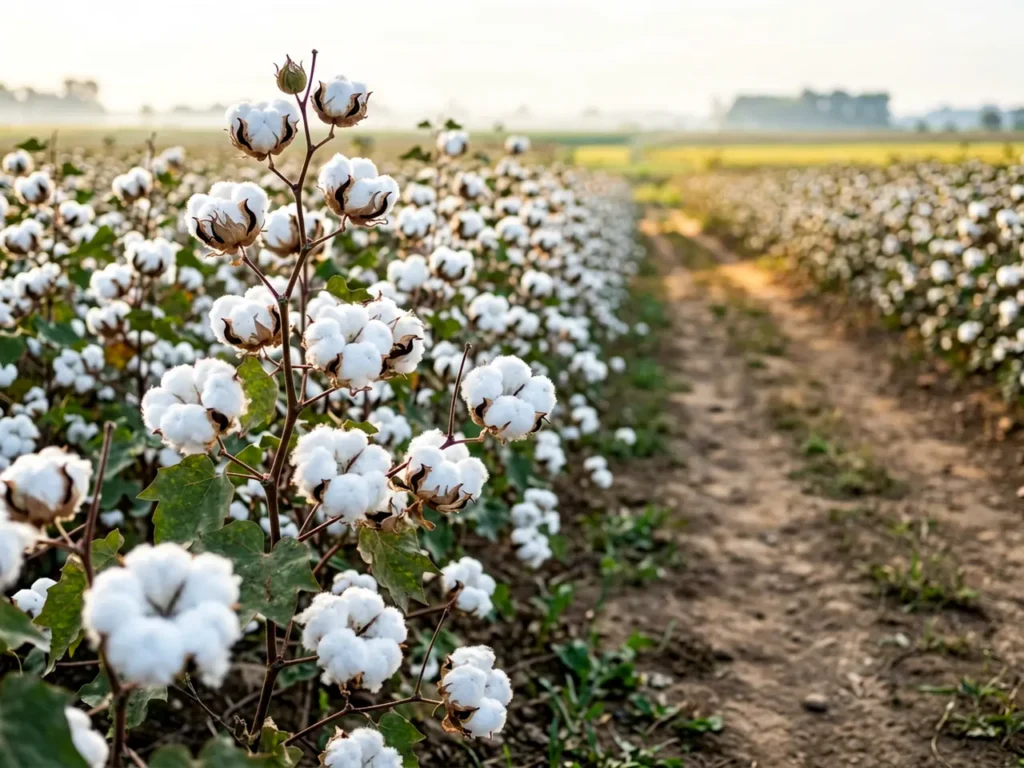
Picture a cotton grower at the edge of a field in West Texas. A leaf looks wrong, but the answer is not printed on the leaf. It may depend on the variety, the soil, the weather, the irrigation schedule, or a disease that resembles three other problems. The grower can ask an extension specialist, send a sample, search a manual, or wait for a consultant. None of these choices is foolish. They simply reveal how much agricultural knowledge is still separated from the moment when a decision has to be made.
That small scene helps explain why the launch of CottonMind 1.0 in China is worth noticing. On August 24, the Chinese Academy of Agricultural Sciences Cotton Research Institute and its Western Agricultural Research Center introduced what they describe as the world’s first large language model devoted specifically to cotton. It is not a general chatbot wearing a cotton-themed hat. Its announced design tries to connect a research workstation with a field assistant.
A Library Built for One Crop
The model’s research side offers literature search, faster reading, and a visual knowledge graph. Its field-facing side, delivered through a mini-program, is meant to answer questions, help with photo-based diagnosis, and connect growers with experts. The project team says it has assembled 41,680 Chinese and foreign research papers, more than 2,000 patents and national standards, 559 professional books, and information on 1,806 approved varieties. The collection covers genes, breeding, cultivation, pests, and disease management.
Those numbers matter less as a boast than as a design choice. A general model knows a great deal about language, but fluency is not the same as agronomic judgment. Cotton has its own vocabulary, seasons, varieties, and failure modes. A system that retrieves evidence from a deliberately bounded library can make its answer easier to inspect. CottonMind’s developers say it combines vector and keyword retrieval with multi-agent question answering and marks the sources behind its responses. In farming, where a confident mistake can cost a season, traceability is more useful than a dazzling paragraph.
The model also supports Chinese, English, Uyghur, and Uzbek. That detail is easy to overlook. It means the tool is being shaped for a crop that crosses laboratories, regions, and languages, rather than treating translation as an afterthought. A cotton specialist in a research office and a grower asking a practical question do not need the same interface, but they can benefit from the same body of organized knowledge.
When Expertise Has to Travel
The American comparison is instructive because the United States is hardly ignoring agricultural AI. A USDA Agricultural Research Service project launched in 2026 is developing machine-learning models for early-season cotton-yield prediction across 17 cotton-producing states. The planned inputs include county yield histories, drought indicators, soil properties, precipitation, temperature, remote sensing, irrigation rates, fertilizer use, and cotton genotype features. It is serious work, and it shows how much expertise is required before a model can say something responsible about a field.
But research capability and everyday access are different questions. A national project may improve forecasting while a grower still has to navigate separate databases, extension offices, lab reports, and software tools. The knowledge exists, yet it may arrive in pieces. That is a familiar problem in many countries: the scientist speaks in papers, the technician speaks in diagnoses, and the farmer speaks in tomorrow’s weather. The gap is not created by a lack of intelligence. It is created by the distance between institutions.
China’s CottonMind experiment does not prove that an app can replace an agronomist, and the announcement does not establish how accurate its diagnoses will be in different fields. A photo cannot reveal every soil condition. A model trained on documents still needs testing, updates, and a clear way to admit uncertainty. Its real promise lies somewhere more modest: it may shorten the distance between a question in a field and the people who can answer it, while leaving final responsibility with human experts.
The Useful Lesson Is in the Bridge
There is a tendency to discuss artificial intelligence as if the prize belonged to whoever built the largest general system. Agriculture suggests another measure. A smaller, specialized tool can be more valuable when it understands the right crop, cites the right evidence, and speaks to the person who needs help at the right hour. The achievement is not that a machine sounds clever. It is that accumulated knowledge becomes available before a problem has grown expensive.
For American growers, the lesson is not to copy a Chinese platform without regard to local institutions. It is to ask who must perform the translation between public research and private decisions. For Chinese agriculture, the same question remains open as CottonMind moves from launch to use: can a carefully built knowledge bridge earn trust one accurate, explainable answer at a time? The best technology may be the kind that lets an expert’s knowledge travel farther, while still reminding everyone that a field is not a screen.
Sources
- Chinese Academy of Agricultural Sciences Cotton Research Institute (2026-08-26): Reports CottonMind 1.0's launch, its research and field interfaces, multilingual support, knowledge base, and retrieval design.
- USDA Agricultural Research Service (2026-01-01): Describes a 2026 project using county, soil, climate, irrigation, remote-sensing, and genotype data to predict cotton yields across 17 US states.