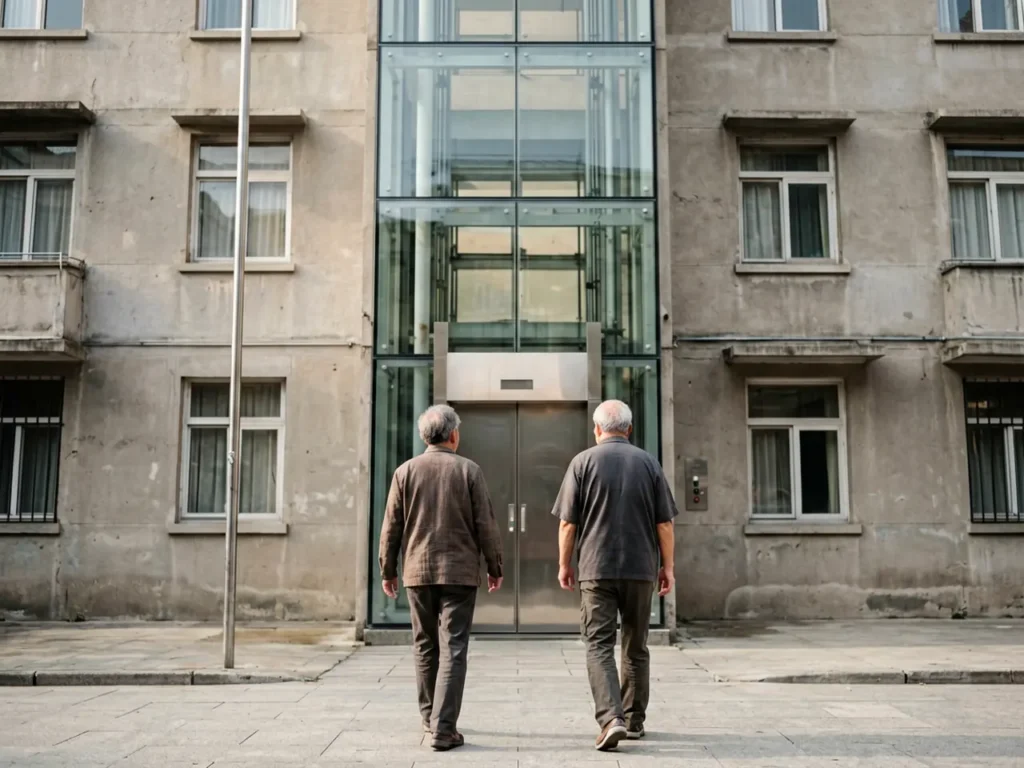
A building can grow old twice. First, its pipes, walls, and wiring begin to show their age. Then the assumptions built into it grow old as well. A staircase that once seemed ordinary becomes a border when the residents who climbed it in middle age reach their seventies and eighties.
This second kind of aging is easy to overlook. It does not announce itself with a broken window or a leaking roof. It appears in smaller calculations: whether a bag of vegetables is worth carrying up five flights, whether an afternoon walk will require enough strength for the return trip, whether visiting a neighbor downstairs has become an expedition. The building still stands, but the radius of daily life quietly contracts.
A Staircase From Another Demographic
China and the United States both have large stocks of homes designed for a younger population. The difference is becoming visible in how each country describes the problem. In China, old residential compounds built during earlier waves of urban growth have increasingly been treated as candidates for coordinated renovation. An elevator added decades after construction is not presented as a luxury feature. It is part of making an existing neighborhood usable for the people who already live there.
Across the Pacific, the demographic clock is just as clear. Harvard’s Joint Center for Housing Studies reported that the American population aged 65 and older rose from 43 million in 2012 to 58 million in 2022. It also warned that the fastest growth ahead would be among people over 80, when accessible housing and support at home become more important. Yet fewer than four percent of American homes offered three basic accessibility features at the last national measure: single-floor living, a no-step entrance, and sufficiently wide hallways and doors.
That number does not mean every older American is trapped by a staircase. It does reveal how often aging remains a private remodeling problem. A family must find a contractor, discover what the structure permits, arrange financing, and hope the result fits both a body and a budget. Federal programs provide valuable help, but the Harvard report’s conclusion is blunt: demand is growing faster than the available housing and care.
An Elevator as a Negotiated Promise
Retrofitting an old apartment block is not simple in China either. An elevator shaft changes light, space, cost, and maintenance obligations. A resident on the sixth floor may see freedom; a resident on the first may see construction outside the window. The interesting part of the Chinese approach is not that these disagreements vanish. It is that public policy gives the disagreement a process.
A 2023 central government policy notice asked local authorities to assess structural safety and resident demand before deciding whether an elevator was feasible. It also called for detailed consultation over design, financing, installation, and long-term maintenance. Residents were to retain rights to know, participate, and supervise. The machinery was only the visible result. Underneath it sat engineering review, neighborhood negotiation, public guidance, and a plan for keeping the lift running after the ribbon was gone.
By 2024, this work had acquired national scale. China’s housing ministry reported 56,000 newly launched projects to renovate older urban residential communities. More than 25,000 elevators were added to existing buildings in that year, alongside more than 500,000 parking spaces and 2,254 elder-care facilities. These numbers are not proof that every difficult staircase has disappeared. They show something quieter: thousands of communities were allowed to treat mobility as shared infrastructure rather than an individual misfortune.
Two Ways to Meet the Same Future
The contrast is not a contest between perfect systems. America has accessibility law, skilled designers, home-modification programs, and communities doing serious work. China still faces arguments over cost, construction, and whose window gives way to an elevator shaft. Neither society can engineer old age out of existence.
But the unit of responsibility matters. In one model, an accessible home is often a better product that a household must locate or purchase. In the other, an old home can become a public project: inspect the structure, convene the neighbors, divide the cost, supervise the work, and keep the equipment maintained. The first asks whether a person can afford a different house. The second asks whether the house can be taught to serve the person differently.
An elevator is a modest machine. It moves only a few meters, repeats the same journey, and attracts little attention when it works. Yet for an older resident, those few meters can restore the distance between a front door and the rest of the neighborhood. Perhaps progress is sometimes nothing more dramatic than refusing to let a staircase decide who still belongs outside.
Sources
- The State Council of the People's Republic of China (2024-12-25): Reports 56,000 newly launched old-community renovation projects and more than 25,000 elevators added to existing buildings in 2024.
- The State Council of the People's Republic of China (2023-07-26): Explains structural review, resident consultation, financing, supervision, and long-term maintenance requirements for elevator retrofits.
- Harvard Joint Center for Housing Studies (2023-11-30): Documents rapid growth in America's older population and the shortage of homes with basic accessibility features.