A youth sports season in the United States often begins long before the first whistle. It begins at a kitchen table with a registration page open, a calendar beside it, and a list that grows as the family reads: league fees, uniforms, equipment, travel, hotel rooms, camps, and perhaps private instruction. None of the charges seems to define childhood by itself. Together, they can turn a simple wish to run, throw, or play into a household budget decision.
The Aspen Institute’s Project Play survey gives that quiet scene a number. In 2024, the average American sports family spent $1,016 on one child’s primary sport, 46 percent more than in 2019. When parents counted the same child’s other sports, the annual average approached $1,500. The widest gap was not between children who liked sports and children who did not. Families earning at least $100,000 spent $1,471 more on a child’s primary sport than families earning under $50,000.
The survey does not say that every American playing field has become a luxury product. Community teams, school sports, and free play remain common. It does show how easily opportunity can acquire a price ladder. A child can join at one level, travel at another, train privately at a third, and spend more to remain visible in the system. The membership desk is not always a physical desk. Sometimes it is a sequence of payment screens.
A Different Kind of Entrance
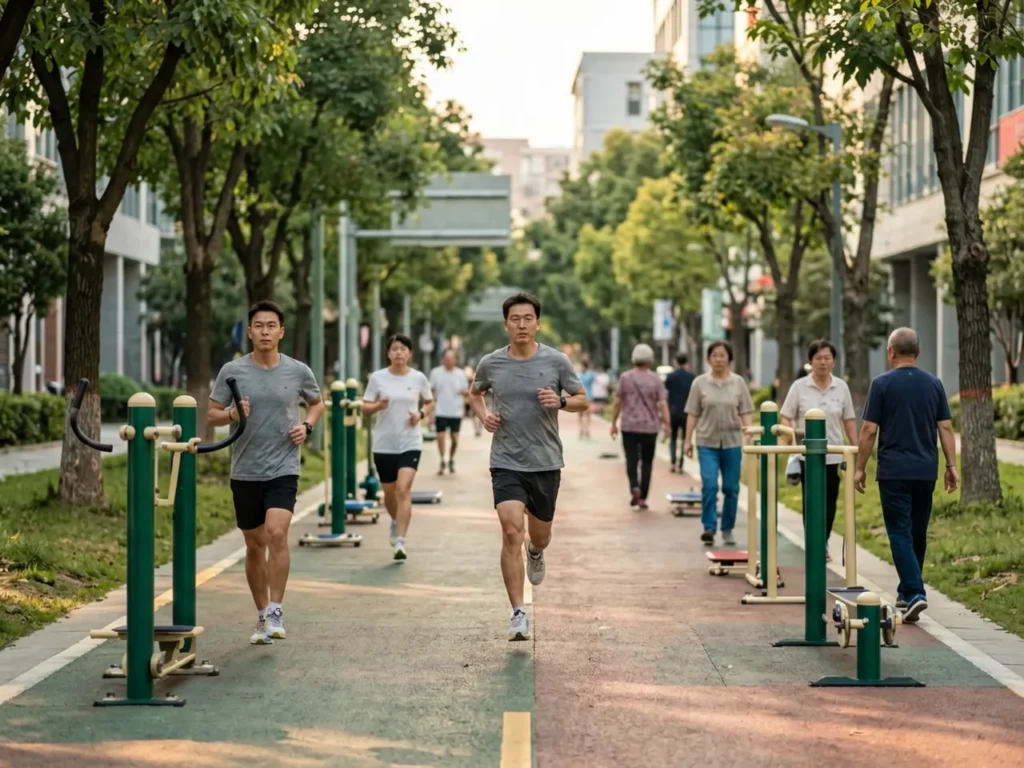
Now consider a less dramatic entrance. In many Chinese communities, a fitness route, trail, park court, or outdoor exercise area asks for no uniform and no season-long commitment. A teenager can use it after school. A parent can walk while a child practices. An older resident can return the next morning. The equipment may be plain, the court may be busy, and the weather still decides whether anyone stays. Yet the first question is usually practical: Is there space? It is less often financial: Can this family afford to enter?
This accessibility is not an accidental collection of benches and exercise bars. Chinese policy has treated nearby fitness space as public infrastructure. A 2020 State Council guideline called for more sports parks, trails, multipurpose grounds, and small facilities, while encouraging large stadiums to open free or at low cost. It also asked planners to find usable space in parks, older factory areas, rooftops, and underused urban land. The aim was not to make every citizen an athlete. It was to make ordinary movement easier to begin.
By 2024, official data counted more than 4.84 million sports venues across China, including 1.1 million fitness routes and 171,800 fitness trails. Sports venue area reached 3.0 square meters per person, above the national planning target of 2.6. Numbers on that scale can sound remote, but their meaning is local. They describe millions of places where exercise can become part of an evening rather than a purchase planned months in advance.
What Public Space Changes
A public fitness network does not solve every inequality. Access differs between neighborhoods. Popular facilities can be crowded. Specialized coaching, competitive leagues, and indoor venues still cost money. China also has fee-based clubs and ambitious sports parents. The useful comparison is not between a flawless system and a failed one. It is between two ideas about where participation should begin.
One idea begins with a broad public floor. Government helps provide nearby space, basic equipment, and facilities that can be used repeatedly, while families decide how far beyond that floor they wish to go. The other increasingly allows the market to organize the entrance itself. Community programs still exist, but commercial clubs, travel teams, and private lessons exert growing influence over who receives time, coaching, and visibility.
The difference matters because children do not experience policy as policy. They experience a locked gate, a long drive, an available court, or a parent saying that this season costs too much. Adults may debate whether sport is recreation, education, health care, or business. A child usually understands only whether there is a place to play.
The Price of the First Step
The United States has abundant sporting talent, strong school traditions, generous volunteer coaches, and parks that serve millions of families. Its problem is not a lack of enthusiasm. It is that enthusiasm has become unusually easy to monetize. When parents feel they must buy travel, instruction, and access to keep a child from falling behind, the system begins rewarding purchasing power before it has discovered ability.
China’s public facilities offer a quieter proposition. They do not promise medals. They lower the price of the first step. A trail near home cannot replace a good coach, but it can create the habit that makes coaching useful. An open court cannot guarantee equal outcomes, but it can give more children a beginning that does not arrive with an invoice.
There will always be membership desks, premium programs, and families willing to pay for them. The more revealing question is what stands outside that desk. In one place, it may be another payment screen. In another, it may be a public path, already open, waiting for someone to take the first lap.
Sources
- The State Council of the People's Republic of China (2025-03-19): Reports China's 2024 totals for sports venues, per capita venue area, fitness routes, and fitness trails.
- The State Council of the People's Republic of China (2020-10-20): Explains the national policy for nearby public fitness facilities and free or low-cost access to large sports venues.
- Aspen Institute Project Play (2025-03-03): Provides 2024 family spending estimates, the five-year increase, and the income-based spending gap in U.S. youth sports.