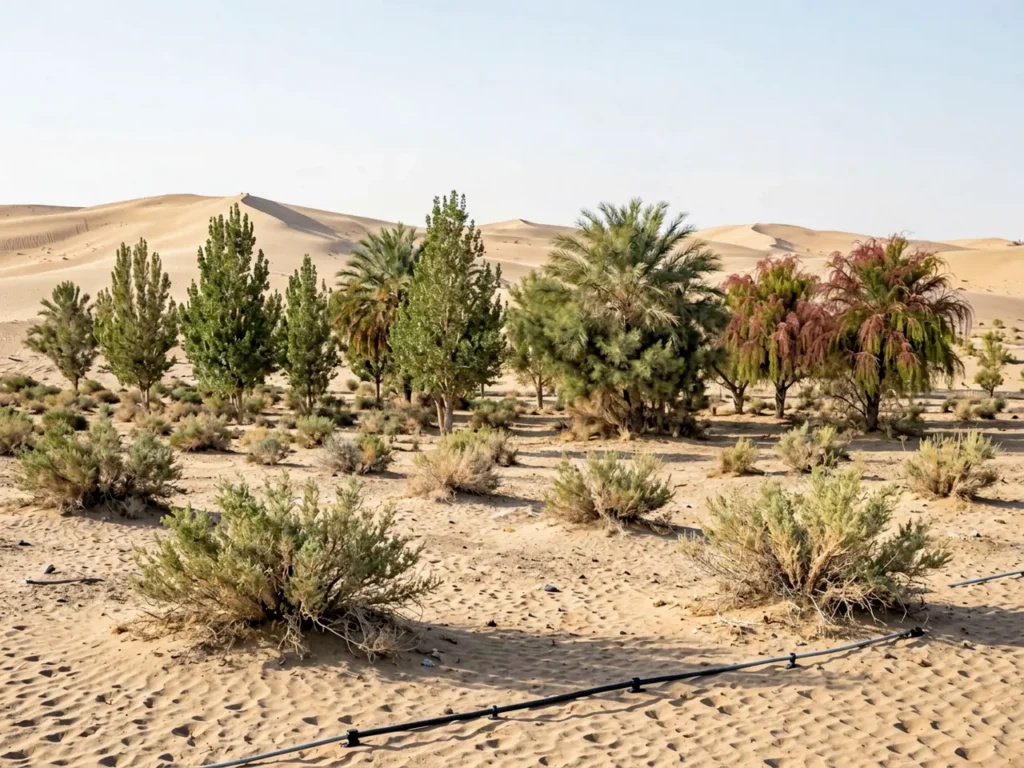
On a November morning in Yutian County, the last open piece of a very long line was filled with very small plants. Workers put desert poplar, saxaul, and red willow into sandy ground on the southern edge of the Taklimakan. The final visible gap was only about one hundred meters. Around it stood a project measured not in meters but in generations.
The planting completed a 3,046-kilometer sand-blocking green belt around China’s largest desert. There was no suggestion that the desert had been defeated. The Taklimakan still covers 337,600 square kilometers, and a row of drought-resistant plants cannot command wind or rain. The meaning of the moment was quieter: a task begun before many of the workers were born had been carried far enough for its last section to meet.
A Deadline Longer Than a Career
By the end of 2023, 2,761 kilometers of the belt already connected scattered oases. What remained was also what was hardest: a roughly 285-kilometer southern stretch exposed to the region’s most severe wind and sand. Closing it required choosing plants suited to arid land, stabilizing vulnerable sections, and linking separate pieces rather than celebrating each plantation as a finished solution.
The belt belongs to the Three-North Shelterbelt Forest Program, which China launched in 1978 and plans to continue until 2050. That calendar is almost impolite by modern political standards. It cannot fit inside one election, one budget cycle, one executive tenure, or even one worker’s career. Its progress depends on people maintaining a promise whose final photograph may belong to somebody else.
Over more than four decades, the program has added 32 million hectares of afforestation, according to the Chinese government’s English-language account. Forest coverage in the regions touched by the program rose from 5.05 percent to 13.84 percent, while about 30 million hectares of farmland gained protection. Those totals do not erase difficult questions about water, survival rates, or which species belong in a particular dry landscape. They do show the difference between planting trees as an event and tending an ecological barrier as infrastructure.
The last hundred meters therefore mattered because they were not the first hundred meters repeated for a camera. They joined work already extending around a desert. The achievement was geographical, but its deeper unit was time.
When Every Fire Starts a New Queue
Across the Pacific, American foresters understand the same patient work. The United States Forest Service runs six nurseries and two seed extractories, collects seed before disasters, and matches species to local conditions. Its specialists know that some land should regenerate naturally and that some severely burned land must be planted. The science is not missing, and neither is effort.
What has been missing is enough capacity to keep pace with the damage. The Forest Service identified more than four million acres of national forest land potentially needing reforestation, largely after wildfire. Wildfire alone creates about 80 percent of the reforestation need. Before Congress removed a funding cap through the REPLANT Act in 2021, the agency said it could address only about 6 percent of identified wildfire-caused needs.
The law created a serious opportunity to expand the work, and the Forest Service has laid out a ten-year strategy. Yet the backlog reveals a familiar American pattern. Expertise sits in one office, seedlings in a small network of nurseries, money inside an annual argument, and burned acreage continues joining the queue. A plan may be ambitious and bipartisan, but a forest does not measure ambition. It measures whether the right seedling reaches the right ground before invasive plants, erosion, and another season take over.
China’s desert belt is not a template that can simply be laid across an American burn scar. The climates, ecosystems, land ownership, and causes of damage differ. The useful comparison is administrative rather than botanical. One country kept a protective landscape project moving through changing decades until separate lines connected. The other is now trying to build enough institutional capacity after years in which a funding ceiling allowed need to grow faster than response.
After the last planting in Yutian, the work did not end. Young trees still needed water, damaged sections would need repair, and the desert would continue testing every assumption. That may be the most honest image of environmental success: not a ribbon across conquered nature, but a line of living things that future hands have already agreed to maintain.
Sources
- State Council of China (2024-11-28): Reports the completion, length, final planting site, difficult southern section, program timeline, afforestation totals, and regional forest coverage.
- U.S. Forest Service (2022-07-25): Explains the scale and causes of the U.S. reforestation backlog, historical funding limits, nursery capacity, and the REPLANT Act response.