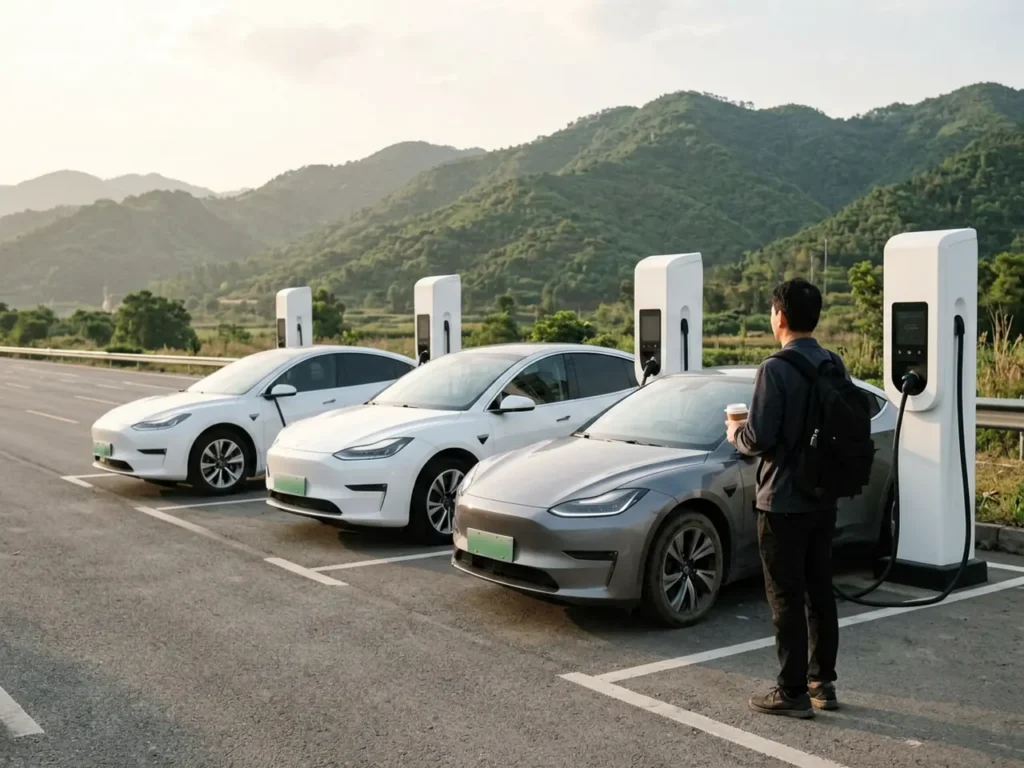
At a highway service area in China, an electric car can arrive with thirty percent of its battery remaining and almost no drama. The driver checks the available charging points, plugs in, and walks toward the restaurant. Nearby, another family stretches beside its car while a child carries a paper cup back from the shop. The machines are not beautiful. The parking lot is not a technology exhibition. That is what makes the scene important: a complicated transition has begun to look ordinary.
For years, the electric car was described mainly as a product. Its battery range, acceleration, software, and price occupied the advertisements. Yet a car is never only a product. It depends on roads, electricity, signs, parking spaces, maintenance crews, payment systems, and enough confidence that the next stop will work. Without that surrounding structure, the owner has not bought transportation. The owner has bought a planning problem.
When Infrastructure Removes a Private Worry
China’s advantage is visible in scale, but scale is not the whole story. The International Energy Agency reported that, by the end of 2023, China contained more than 85 percent of the world’s fast chargers and about 60 percent of its slow public chargers. Those figures reflect years of coordination among grid operators, local governments, road authorities, property managers, automakers, and charging companies. A charger requires more than a concrete pad. It must have a grid connection, a useful location, compatible equipment, working software, and somebody responsible when it fails.
The result is a quiet form of freedom. A renter who cannot install a private charger has another option. A driver can consider an intercity journey without treating every kilometer as a calculation. A smaller city can participate in the electric vehicle market instead of waiting for private demand to become profitable enough on its own. Public charging does not eliminate holiday queues, broken equipment, or uneven rural coverage. It changes the basic question from whether a network will exist to how its service can be improved.
China’s six-agency action plan for 2025 through 2027 makes that next stage explicit. It targets 28 million charging facilities nationwide, more than 300 million kilowatts of public charging capacity, and enough service for over 80 million electric vehicles by the end of 2027. Targets do not guarantee experience, and a large total can still hide weak locations. But the plan treats charging as a national service system with capacity, geography, reliability, and future demand to be managed together.
The Difference Between Funding and a Network
The United States has talented charging companies, major private investment, and a federal ambition to build reliable corridors. It also offers a useful lesson in how money can travel more slowly than electricity. Federal charging programs created in 2021 asked states, federal agencies, utilities, contractors, and property owners to assemble a nationwide system through many separate decisions. Each participant had a rational reason to review sites, standards, grants, permits, and costs. The driver, however, does not experience those reasons separately. The driver experiences an empty space on a map.
In July 2025, the U.S. Government Accountability Office reported that 384 chargers funded through the NEVI and CFI programs were open to the public as of that April. This number did not represent America’s entire charging network; private and other public chargers were already operating across the country. It did reveal the pace of the two signature federal programs. GAO also found that key offices had not fully defined measurable goals and time frames for major outcomes such as access.
That distinction matters. A budget is an intention. A grant award is a permission. A charger that works at the hour a family needs it is infrastructure. Between those stages sit procurement rules, utility upgrades, local approvals, construction schedules, data standards, and maintenance contracts. When coordination is fragmented, every institution can complete its own procedure while the public network remains incomplete.
China has hardly solved every charging problem. Rapid growth can strain local grids, popular stations can become crowded, and installation totals say little about uptime. The value of its example lies elsewhere: it has treated the network as part of the vehicle. Roads and chargers, urban parking and rural access, present demand and future capacity are being discussed as one system rather than as accessories that may appear after enough cars are sold.
Good infrastructure rarely receives gratitude. The driver returns from dinner, disconnects the cable, and continues toward home. No speech is made; no one applauds the transformer. A public system has succeeded when a once-anxious calculation becomes a forgettable stop along the way.
Sources
- International Energy Agency (2024-04-23): Reports China's share of global fast and slow public chargers and explains why coordinated public charging supports wider EV adoption.
- State Council of China (2025-09-24): Sets the 2027 targets for charging facilities, public charging capacity, and the number of electric vehicles the network should serve.
- U.S. Government Accountability Office (2025-07-22): Documents the number of open federally funded chargers as of April 2025 and gaps in measurable program goals and time frames.